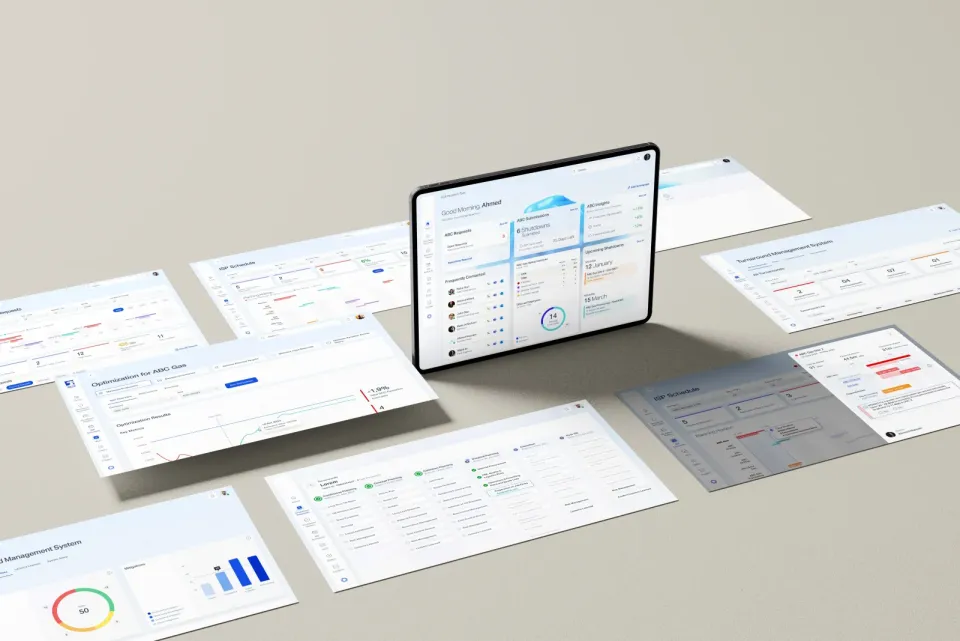
What is a turnaround, and what was wrong with the old way?
A turnaround is the planned shutdown of an oil and gas plant for maintenance. It takes months of planning, and many departments have to agree on resources, schedules and risks. At ADNOC, that planning lived in emails, spreadsheets and disparate tools, offline and online, and none of it worked together.
Workshops with the people who run turnarounds showed three problems:
- No transparency. It was hard to see the progress and status of a shutdown.
- Little collaboration. Email chains got in the way of teamwork.
- Lost time. The process wasted time, and people wanted to finish tasks faster and with fewer mistakes.
What did I do?
IBM iX built ADNOC one system to manage turnarounds, where every department tracks progress live and shares information in one place. I worked on it from the first workshops through two phases of design:
- WorkshopsWorkshops with each type of user to map the current process, how departments talk to each other, and where time is lost.
- Information architectureListed every module and built the IA, so 30+ modules could be designed in parallel and still fit together.
- Co-designWireframed modules with the client and developers, then turned them into product screens through regular playbacks.
- ConsistencyTook on the design system and wrote a design handbook, so ten designers built screens the same way.
What did we learn from users?
- Every company did turnarounds differently. The process varied across the companies in the group, so the system had to be modular.
- People didn't know their next step. Many weren't sure of their role in the process, so clear workflows mattered as much as screens.
- Email cost the most time. The offline, email-based process was the biggest waste, and the clearest case for one digital system.
How was the project run?
In phases, so we could deliver and learn. Phase one mapped the current workflow, listed the modules, built the IA and the first screens with the client. Phase two revisited each module with developers and the client and standardised the screens. Phase three planned user testing and automating more of the process.
As the design team grew to ten people on 30+ modules, consistency slipped under tight deadlines. I took that on: page templates, guidelines and a design handbook. That part has its own case study, ADNOC: scaling a starter design system.